
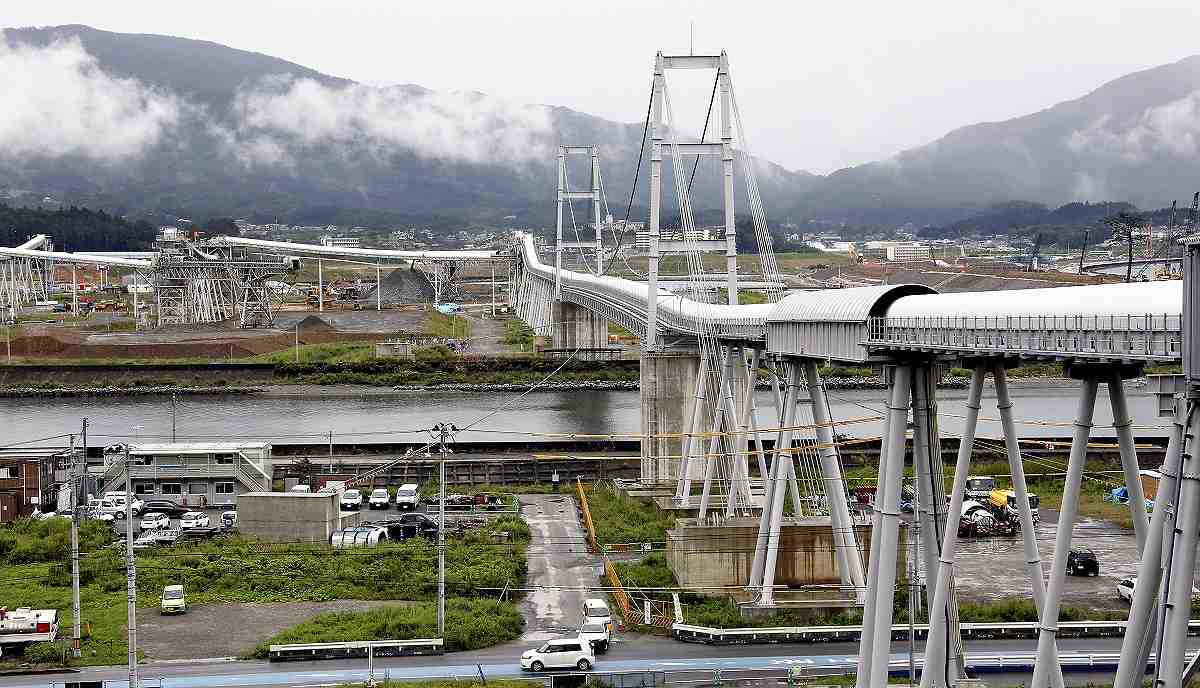
A conveyor belt to transport earth and sand from higher ground, foreground, to the area being elevated, rear, is seen in Rikuzentakata, Iwate Prefecture, in August 2015.
11:27 JST, January 15, 2021
Involving a massive tsunami and a nuclear power plant accident, the Great East Japan Earthquake was an unprecedented and complex disaster. This year marks a decade since the disaster occurred in March 2011. As symbolic moments we still remember are examined once again, untold stories have come to light. This is the first installment of a series featuring such stories.
This spring, a civil engineering reconstruction project is finally scheduled to be completed. The project is to elevate the ground of Rikuzentakata, Iwate Prefecture. An area as large as 2½ times the size of Tokyo Disneyland is being raised to 10 meters above sea level using earth equivalent to nine times the volume of Tokyo Dome. This is one of the gigantic projects being undertaken in disaster-stricken areas, but the initial plan was to raise the ground only 2 meters. Over about two years, the scale of the project has been expanded five times.
A tsunami more than 10 meters high hit the city’s vast downtown area, killing 1,606 people there. About 4,000 houses, half of the number in the city, were damaged by the disaster, and the city lost all its functions. At that time, local residents earnestly wanted efforts to be made to prevent their towns from being devastated by such a disaster again. So they sought to make them stronger and more resilient.
Civil engineering methods are limited. To make the area more able to withstand future disasters, there are only three options: building a seawall, relocating the area to higher ground and elevating the ground of the area.
Rikuzentakata Mayor Futoshi Toba initially requested that the Iwate prefectural government build a 15-meter-high seawall. The ground was also set to be elevated, but at that time, the main purpose was simply to restore it to its pre-earthquake height, so the ground was only going to be elevated to 2 meters above sea level.
However, the height of the seawall decided by the prefectural government was 12.5 meters. The prefectural government determined the height based on the conclusion that disaster mitigation would be possible in combination with proper evacuation. Plans to develop residential land were also studied, but there was no suitable land to relocate housing to. This left the city with only one option.
The Reconstruction Design Council, an advisory body for the prime minister, has also advocated implementing various measures – including elevating the ground – to ensure multiple forms of protection. Given this, the city government anticipated that it could obtain state funds and changed the planned elevation height to 5 meters above sea level in the autumn of 2011. From this point on, the scope of the project began expanding.
Backed by the mayor, who said, “It is meaningless if people say it’s too scary to live there,” the elevation height was changed again a year later to an average of 9 meters above sea level.
The change stands to reason. As the JR Ofunato Line was expected to continue running through the low-lying area, a multilevel crossing was planned for roads in the center of the city. This would have required sufficient height, but it was thought that earth and sand generated by the construction of residential land on higher ground could be used. At any rate, the central government had asked for local disposal of that earth and sand out of concern over the cost of transporting it.
After ground improvement was also sought for the project, another change in the average elevation height soon followed, this time to 10 meters above sea level. The construction period, which was originally planned for five years, was extended by two years. What would happen to the city if the project was delayed? At the time, however, city officials simply thought that the residents would not criticize the project as long as the elevation became higher.
Even though the project cost ballooned to ¥165.7 billion from the original ¥120.1 billion, the local governments felt no pain. This is because the central government reduced the financial burden on them to zero, using revenues such as those from the reconstruction tax hike to fund such projects.
“We took away the incentive to reduce the scale of the project,” said Masakatsu Okamoto, who served as vice minister of the Reconstruction Agency.
An academic who was involved in the reconstruction plan said the project was run like a car without brakes.
Five years ago, East Japan Railway Co. decided to introduce a bus rapid transit system to replace the railway section damaged by the disaster. As a result, the planned multilevel crossing became unnecessary. It then turned out that the volume of earth and sand generated by the development of building houses on higher ground would be 10% less than expected. Transporting the earth and sand outside the area also gradually received tacit approval at that time.
Even so, the scale of the project was not reduced.
“Reviewing the plan would take as much time as construction,” a senior official of the city government said.
Toshihiro Kanno, 68, who lost his home in the disaster, raised questions over the huge scale of the project during a briefing session conducted by the city government. But he also said: “Everyone had their hands full rebuilding their lives. We didn’t have time to think about what the city would look like after reconstruction.”
Many people affected by the disaster have already rebuilt their homes on higher ground or in other areas. Currently, 60% of the area reinforced under the project is vacant.




Most Read
Most read in the last 24 hours
Most read in the last 7 days
Most read in the last 30 days
-

Mazda Launches Fully Redesigned CX-5 SUV in Japan; First Time in ...
-

Japanese Language Schools: Improving Education for Foreigners Is ...
-

Japan Prime Minister Sanae Takaichi, S. Korea President Lee Jae M...
-

Typhoon Jangmi Approaching Okinawa Prefecture, Amami Islands; Sev...
-

Listed Companies’ Financial Results: Enhance Crisis Management Sk...
-

Japan to Begin World's First Trial Sales of Artificially Hatched ...
-

Punch and Other Monkeys to Get AC, Bigger Yard at Japanese Zoo
-

Typhoon Jangmi Expected to Develop into Large, Powerful Storm, Re...
Top Articles in Editorial & Columns
-
Japanese Language Schools: Improving Education for Foreigners Is an Urgent Task
-
GDP Growth: Measures Must be Devised to Prevent Economic Downturn
-
Naphtha Supply Issue: Govt Must Face Concerns of Businesses, Households Head-on
-
Fed Chair’s Swearing-in: Uphold Independence to Ensure Price Stability
-
Government and Generative AI: Do Cabinet Members Understand Gravity of Responses to Diet Questions?
JN ACCESS RANKING
-
Mazda Launches Fully Redesigned CX-5 SUV in Japan; First Time in 9 Years
-
Japanese Language Schools: Improving Education for Foreigners Is an Urgent Task
-
Typhoon Jangmi Approaching Okinawa Prefecture, Amami Islands; Severe Winds, Warning-Level Heavy Rain Expected ( UPDATE1 )
-
Punch and Other Monkeys to Get AC, Bigger Yard at Japanese Zoo
-
Typhoon Jangmi Expected to Develop into Large, Powerful Storm, Reach South of Okinawa by Monday
Most read in the last 24 hours
Most read in the last 7 days
Most read in the last 30 days
-
Mazda Launches Fully Redesigned CX-5 SUV in Japan; First Time in ...
-
Japanese Language Schools: Improving Education for Foreigners Is ...
-
Japan Prime Minister Sanae Takaichi, S. Korea President Lee Jae M...
-
Typhoon Jangmi Approaching Okinawa Prefecture, Amami Islands; Sev...
-
Listed Companies’ Financial Results: Enhance Crisis Management Sk...